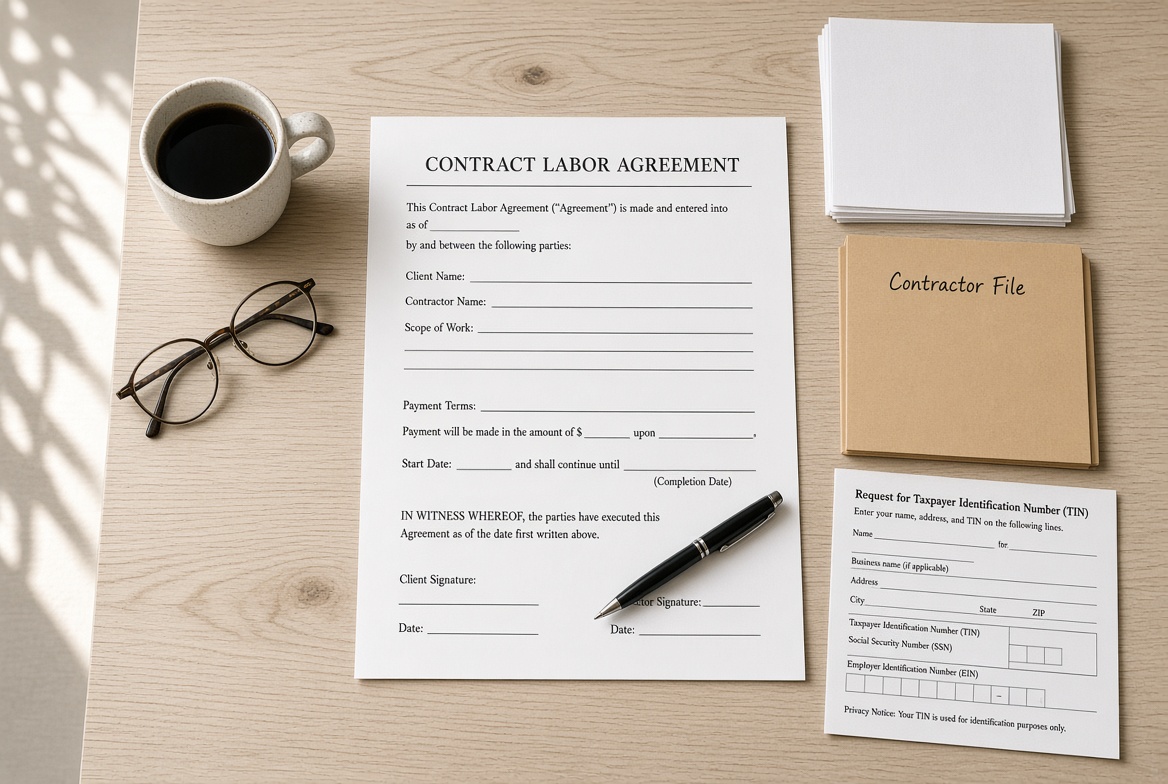
Free Printable Contract Labor Agreement Form (USA) – A free printable contract labor agreement form is the written contract most U.S. businesses and workers use when hiring someone as a contractor instead of an employee. People also search for it as an independent contractor agreement, 1099 contractor contract, freelance agreement, or contract labor form.
There is no single official federal “contract labor agreement” form. The IRS and U.S. Department of Labor do not publish a fill-in-the-blank labor contract. They do publish the tax and classification rules that should sit behind any agreement you use.
This page explains what the form covers, how it differs from an employment contract, where you can download a legitimate free printable, and which official IRS forms usually go with it.
What is a Contract Labor Agreement?
A contract labor agreement is a private contract between a client (the person or business paying for the work) and a contractor (the person or business doing the work).
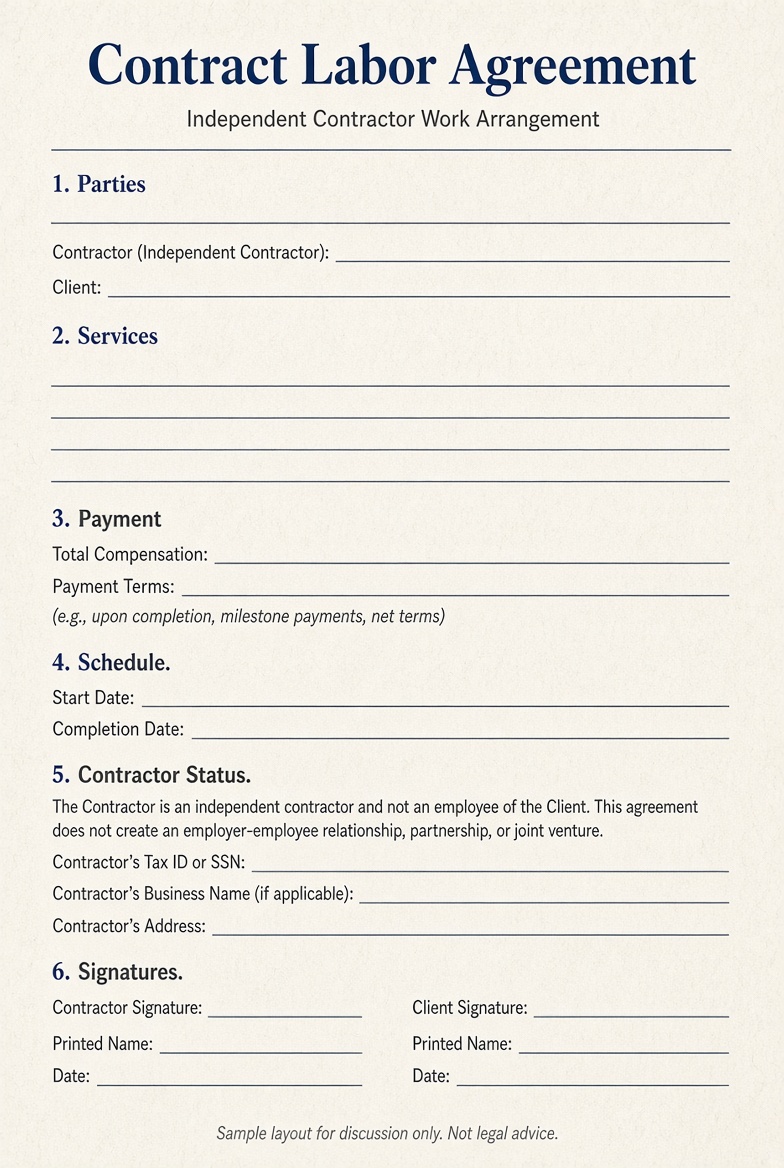
It typically records:
- Who the parties are
- What work will be done
- When the work starts and ends
- How and when the contractor gets paid
- Who owns the finished work
- That the worker is an independent contractor, not an employee
- How either side can end the arrangement
In everyday U.S. use, “contract labor” usually means a 1099 contractor: a self-employed person, freelancer, consultant, tradesperson, or small business hired for a project or defined service.
It is not the same as:
- An employment contract for a W-2 employee
- A union collective bargaining agreement
- A farm labor contractor registration form from the Department of Labor
Those documents serve different legal purposes.
Why a Written Form Matters?
A handshake deal can still be a contract. A written form is easier to prove.
A clear agreement helps both sides:
- Set the scope before work starts
- Avoid disputes over extra work, late payment, or missed deadlines
- Show that the relationship was intended as contractor work
- Create a paper trail for invoices, insurance, and tax reporting
A signed form does not automatically make someone an independent contractor. The IRS looks at the real working relationship, not just the label on the page. The Department of Labor makes the same point for federal wage-and-hour rules: signing an independent contractor agreement does not, by itself, decide worker status.
Review the IRS guidance on independent contractor vs. employee classification{rel=”nofollow” target=”_blank”} before you treat a worker as contract labor.
Free Printable Contract Labor Agreement Forms
These two sources currently offer usable free documents for U.S. contractor work. Download the file, fill in the blanks, and print it. Do not treat either template as legal advice for your state or industry.
1. eForms independent contractor agreement (PDF and Word)
eForms publishes free independent contractor agreements{rel=”nofollow” target=”_blank”} in PDF, Microsoft Word, and OpenDocument formats. The page includes a short version and a longer version, plus state-specific pages for all 50 states and Washington, D.C.
The simple version is the closest match if you searched for a free printable contract labor agreement form. The longer version is better when you need insurance, indemnification, expenses, and assignment clauses.
You can print the PDF as-is or edit the Word file first. Read every clause before anyone signs.
2. Freelancers Union contract creator
Freelancers Union offers a free browser-based Contract Creator{rel=”nofollow” target=”_blank”} built for U.S. freelance and contractor work. You enter the parties, scope, rate, and payment schedule, then download a Word or PDF file.
This option is useful if you want a guided form rather than a blank template. It is especially practical for freelancers, consultants, designers, and other service contractors.
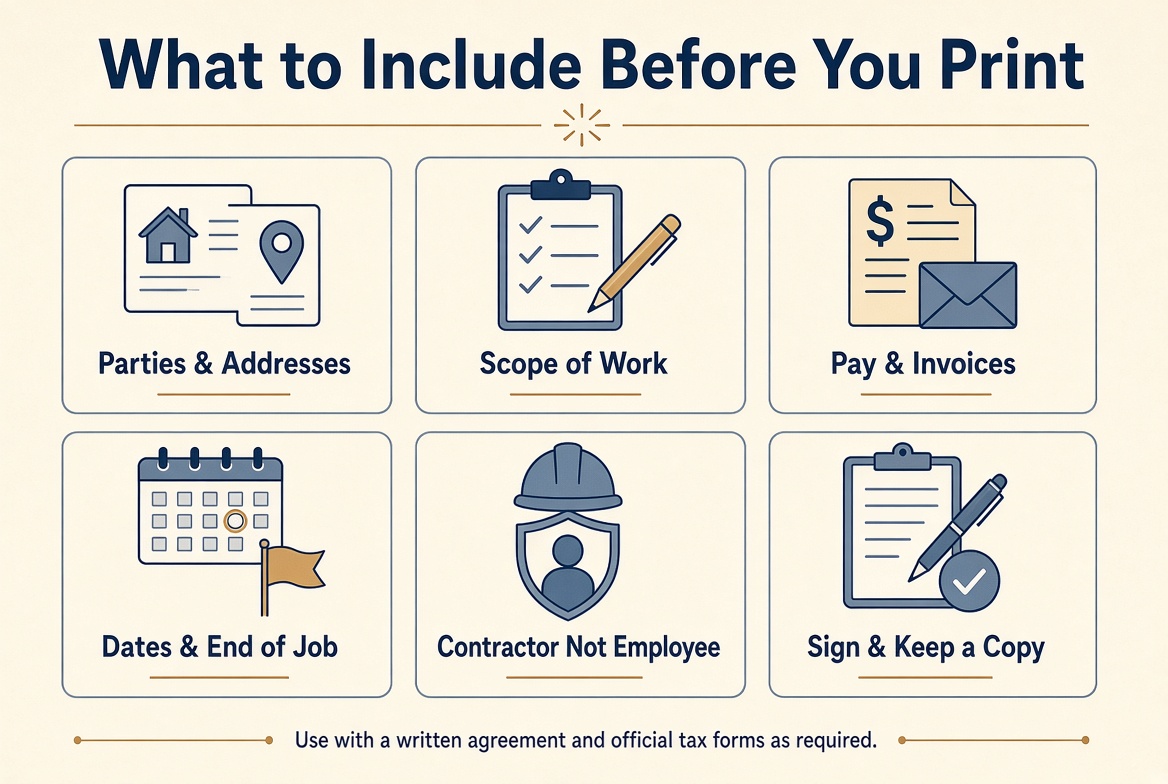
What to Put in the Form Before You Print
A usable contract labor agreement should answer the questions that cause most disputes.
- Parties. Use legal names, mailing addresses, and business names if either side operates as an LLC or corporation.
- Scope of work. Describe the result, not a job description. “Install kitchen cabinets at 14 Oak Street by October 15” is clearer than “general carpentry help.”
- Payment. State the rate (flat fee, hourly, milestone, or retainer), when invoices are due, and whether late fees apply. Say who pays for materials, travel, permits, or subcontractors.
- Schedule. Include a start date, end date or completion trigger, and any milestone dates.
- Contractor status. State that the worker is an independent contractor, controls how the work is done, uses their own tools when that is true, and is responsible for their own taxes and insurance.
- Intellectual property. Say who owns the finished work, photos, code, designs, or written materials after payment.
- Confidentiality. Add this if the contractor will see customer lists, pricing, or unpublished business information.
- Insurance. Construction, delivery, and many trade jobs often require general liability coverage. Some clients also ask for proof of workers’ compensation or auto insurance.
- Termination. Explain how either party can end the job, how much notice is required, and how finished work is paid.
- Governing law. Name the U.S. state whose contract law will apply. That is usually the state where the work is performed.
Leave blanks only where you will fill in real details. Do not sign a form that still says “[CLIENT NAME]” or “[DESCRIBE SERVICES].”
How This Differs From Hiring an Employee?
If you control when, where, and how the person works, supply the tools, pay a regular wage, and treat the role as part of your core staff, the worker may be an employee even if both of you signed a contractor form.
The IRS groups the facts into three buckets:
- Behavioral control — who directs how the work is done
- Financial control — who pays expenses, supplies tools, and can profit or lose money
- Type of relationship — written contract, benefits, permanency, and whether the work is a regular part of the business
State tests can be stricter. California’s ABC test is a common example. If the work is in a highly regulated state or industry, have a local attorney review the form.
The Department of Labor also warns that a signed contractor label does not control federal wage rules if the economic reality looks like employment. See its page on misclassification myths.
Tax Forms That Usually Go With the Agreement
The contract labor agreement is not an IRS form. These official forms often travel with it.
Form W-9. Collect this from a U.S. contractor before the first payment. It gives you the legal name and taxpayer identification number you need for year-end reporting. Download it from the IRS page for Form W-9, Request for Taxpayer Identification Number and Certification{rel=”nofollow” target=”_blank”}.
Form 1099-NEC. If you pay a nonemployee for services in the course of your trade or business, you may have to file Form 1099-NEC and give the contractor a copy by January 31 of the following year.
For payments made in 2025, the common federal reporting threshold was $600. For payments made after December 31, 2025, IRS instructions use a $2,000 federal threshold for many 1099-NEC payments. Confirm the current instructions for the year you are reporting, and check whether your state still uses a lower threshold.
A 1099 does not decide classification. It only reports payments. The contractor still reports the income. Net self-employment earnings of $400 or more generally trigger self-employment tax.
Keep the signed agreement, W-9, invoices, and proof of payment together. That file is what you will need if the IRS or a state agency asks how the worker was classified.
Free Printable Contract Labor Agreement Form (USA)

How to Use a Free Printable Form Safely?
- Confirm the worker can legally be treated as a contractor under federal and state tests.
- Download a current template from one of the sources above.
- Fill in names, scope, pay, dates, insurance, and governing state law.
- Remove clauses that do not apply. Do not leave contradictory language in the document.
- Collect a completed Form W-9 from a U.S. payee.
- Have both parties sign. Electronic signatures are valid under federal e-sign rules in most routine business contracts.
- Give each side a signed copy and store it with the invoices.
If the job is high-dollar, involves construction or licensed trades, includes minors, or will last many months with close daily supervision, get state-specific legal review. A free template is a starting point, not a substitute for advice about your facts.
FAQ
Is there an official U.S. government contract labor agreement form?
No. The IRS and DOL publish classification and tax guidance, not a standard printable labor contract. Use a private template and the official tax forms that match the relationship.
Can I use one form in every state?
You can start with a general U.S. template, then add the governing-law state and any state-required terms. Worker-classification rules are not identical in every state.
Does a free printable form make the worker a 1099 contractor?
No. The written label helps, but agencies look at control, finances, and how the relationship actually works.
Do I still need a W-9 if I use a contract labor agreement?
Yes, if you are paying a U.S. contractor and may have to file an information return. The agreement does not replace Form W-9.
Should both sides keep a printed copy?
Yes. Keep the signed agreement with invoices, change orders, and proof of payment.
A free printable contract labor agreement form is useful when it is filled in carefully and matched to the real working relationship. Download a current template, pair it with the official IRS forms, and have a lawyer review anything that is unusual, high-value, or close to employment.